
on WeChat to
follow us

Research
Follow

Address
92 Xidazhi Street, Nangang District, HarbinZipcode
150001Tel
0451-86413909,86402590 10
10 Recently, the research team led by Professor Yanhong Tian from the State Key Laboratory of Precision Welding and Joining of Materials and Structures at Harbin Institute of Technology has achieved significant progress in the field of flexible moisture-electric generators. The related findings, entitled “Interfacial Engineering for High-Output, Mechanically Robust Fully Stretchable Moisture-Electric Generators,” have been published in Nano-Micro Letters, a leading journal in the fields of materials science and nanotechnology.
With the rapid advancement of wearable and implantable electronic devices, energy systems that simultaneously integrate flexibility, stretchability, and stable power supply capabilities under dynamic environmental conditions have become increasingly desirable. However, achieving continuous and reliable electrical output under complex mechanical deformations remains a critical challenge in the field of flexible energy technologies. Hydrogel-based moisture-electric generators, which harvest electrical energy from ambient moisture through an ion migration mechanism, have demonstrated remarkable potential owing to their ability to deliver high current outputs under all-weather conditions. Nevertheless, fully stretchable hydrogel-based moisture-electric generators are generally limited by insufficient interfacial adhesion between functional layers, which results in degraded electrical output performance and compromised mechanical stability when subjected to complex deformation.
To address the aforementioned bottlenecks, the research team proposed an innovative interfacial engineering strategy that enables the simultaneous enhancement of both the electrical output performance and mechanical robustness of the device. In this strategy, a highly adhesive hydrogel swollen in a water–glycerol binary solvent was integrated between the liquid metal and stretchable silver electrodes, successfully constructing an entirely stretchable moisture-driven power generation device. The incorporation of glycerol effectively exposes more hydrogen-bonding functional groups, thereby increasing the effective contact area and interfacial adhesion between the hydrogel and electrodes, ultimately establishing a robust and durable hydrogel–electrode interface. This design not only reduces interfacial resistance and ensures efficient charge transport under mechanical deformation but also significantly suppresses delamination-induced failure under large strains. Furthermore, glycerol endows the hydrogel with excellent anti-drying, anti-freezing, and anti-swelling properties, further improving the environmental adaptability and long-term operational stability of the device. Benefiting from the aforementioned interfacial design, the developed stretchable moisture-driven generator exhibits outstanding performance, including an open-circuit voltage of 0.94 V, a current density of 141 µA cm⁻², and stable power output maintained for over 220 hours. Moreover, the device demonstrates exceptional mechanical durability, with nearly negligible performance degradation after 8000 folding cycles and 1000 stretching cycles under an 80% strain condition. Owing to these remarkable advantages, the device can directly power low-power wearable electronic systems without the need for external energy sources. In addition, by utilizing humidity-sensitive responses induced by human respiration, it enables real-time monitoring of sleep apnea syndrome, highlighting its great potential for applications in self-powered wearable medical diagnostics.
This study highlights the critical role of interface-centered design principles in advancing flexible energy systems and provides a universal strategy for enhancing interfacial reliability in flexible electronic devices. The demonstrated approach paves a new pathway toward the development of self-powered wearable systems capable of long-term operation under complex environmental conditions and dynamic mechanical stresses.
The first author is Qi Meng, a Ph.D. candidate at the Zhengzhou Research Institute of Harbin Institute of Technology, and the co corresponding authors are Professor Yanhong Tian from the State Key Laboratory of Precision Welding and Joining of Materials and Structures, Associate Researcher Qing Sun from the Catalan Institute of Energy Research in Spain, and Dr. He Zhang from the University of Hong Kong.
This work was supported by the National Key R&D Program of China (Grant No. 2025YFE0125100), the Heilongjiang Province Key Research and Development Program (Grant No. 2022XJ03C07), and the National Natural Science Foundation of China (Grant No. 52175300).
Article link: https://doi.org/10.1007/s40820-026-02234-4
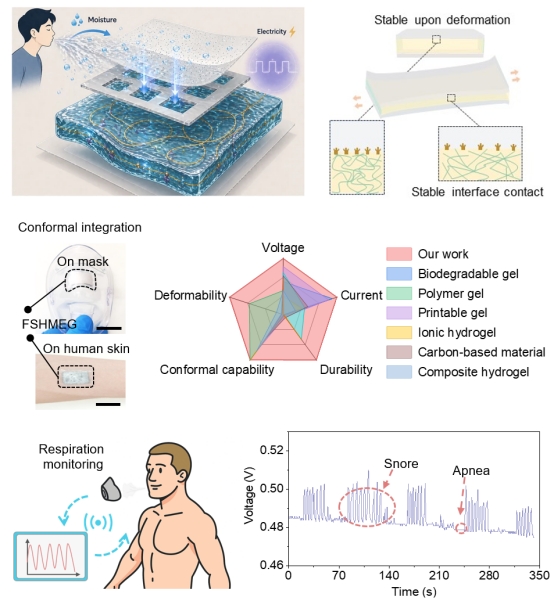
An Interfacial design strategy for High‑Output, Mechanically Robust Fully Stretchable Moisture‑Electric Generators