

on WeChat to
follow us

Research
Follow

Address
92 Xidazhi Street, Nangang District, HarbinZipcode
150001Tel
0451-86413909,86402590 10
10 Recently, Professor PingAn Hu’s research team at the School of Materials Science and Engineering, Harbin Institute of Technology (HIT), has made notable advances in robotic systems. Working in interdisciplinary collaboration with Professor Li Jiang’s team from the School of Mechatronics Engineering, the group targets rapid, non-invasive liquid identification and intelligent sorting for complex scenarios. The team innovatively proposed a non-visual rapid detection technology that integrates artificial intelligence (AI) with bioinspired tactile sensing, providing a novel robotic equipment solution for security screening at large-scale events, counter-terrorism explosive ordnance disposal, and the intelligent sorting of flammable and explosive liquids in sealed containers. Relevant findings have been published in the top-tier international journal Advanced Materials, under the title Bioinspired Rheological Sensing for Robotic Liquid Identification in Sealed Containers via Ultrafast Incipient Slip Detection.
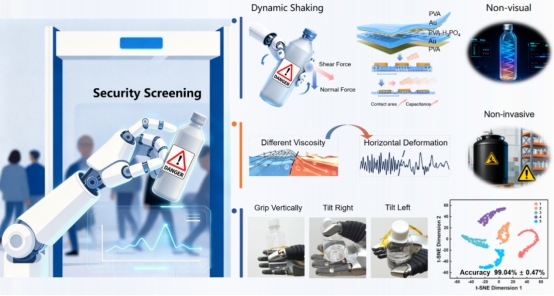
Schematic diagram illustrating the working principle and application of the intelligent robot non-destructive rapid testing system for sealed hazardous liquids
Rapid, non-invasive identification of liquids within sealed containers is critical to public safety for complex scenarios including airport security checks, large-scale-event security operations, and industrial hazardous-material inspection. Conventional detection approaches frequently suffer from invasive handling procedures, which are time-consuming, labour-intensive, and carry inherent risks of sample damage and contamination. Moreover, non-contact techniques built upon vision or spectroscopy often malfunction when encountering opaque containers or low-light operating environments.
To address this key technical bottleneck, Professor PingAn Hu’s team moved beyond the traditional framework of vision and spectroscopy-based detection and successfully developed a non-visual liquid identification robotic system. Drawing inspiration from everyday human behaviour, in which people judge liquid states by shaking a vessel and perceiving its tactile feedback, the team developed a bioinspired iontronic tactile sensor with an interlocked “protrusion-groove” structure, which was subsequently integrated onto a robotic fingertip. This core device simulates the synergistic coding mechanism of mechanoreceptors within human skin. It amplifies highly localized and transient incipient slip at the contact interface into clear transient capacitance signals, achieving a slip response time as fast as 46 ms.
Requiring no cap opening or invasive procedures, the robotic hand simply performs dynamic shaking on fully sealed containers and functions entirely without visual input. The integrated sensing system effectively captures the transient signals generated by the internal liquid’s dynamic interactions, such as differences in density and viscosity. By extracting physical features from the signals and applying a Random Forest classifier for deep decoding, this intelligent robotic equipment enables non-visual liquid identification for diverse concealed liquids in sealed containers, with an accuracy of 99.04% ± 0.47%.
This work provides a practical solution for non-visual liquid identification and demonstrates a robust approach for enabling robots to achieve multimodal tactile perception, laying a solid theoretical and technical foundation for the automated inspection of hazardous materials and smart sorting of sealed explosives in special environments.
HIT serves as the sole corresponding institution for this paper. Huiwen Ren, a PhD candidate from the School of Materials Science and Engineering, is the first author, and Professor PingAn Hu is the corresponding author. Wangyang Li and Hexin Li from the School of Mechatronics Engineering also contributed to this research. This work was supported by the National Natural Science Foundation of China under the Basic Science Center Program for “Space Robot Intelligent Manipulation” (Grant No. T2388101) and National Natural Science Foundation of China (NSFC, No. 52372042).
Paper Link: doi.org/10.1002/adma.73955