
on WeChat to
follow us

Research
Follow

Address
92 Xidazhi Street, Nangang District, HarbinZipcode
150001Tel
0451-86413909,86402590 10
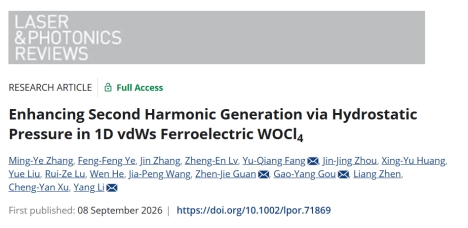
10 Recently, the research team led by Professor Yang Li from our School of Materials Science and Engineering, together with collaborators from Shanghai Jiao Tong University, Xi’an Jiaotong University, and other institutions, has made progress in the nonlinear optical modulation of one-dimensional van der Waals ferroelectric materials. The related results, entitled “Enhancing Second Harmonic Generation via Hydrostatic Pressure in 1D vdWs Ferroelectric WOCl4,” have been published in Laser & Photonics Reviews (a top optics journal and a CAS-JCR Zone 1 TOP Journal). The co-first authors of the paper are Ming-Ye Zhang, a senior undergraduate in our School of Materials Science and Engineering, and Feng-Feng Ye, a doctoral student at Xi’an Jiaotong University. The corresponding authors are Professor Yang Li, Associate Researcher Zhen-Jie Guan, Associate Researcher Yu-Qiang Fang, and Professor Gao-Yang Gou.
As a typical one-dimensional van der Waals ferroelectric material, WOCl4 possesses a unique corner-sharing chain structure of [WO2Cl4] octahedra, which endows it with a strong quantum confinement effect and intrinsic spontaneous polarization, giving it broad application prospects in ultrahigh-density integrated photonics and tunable optoelectronic devices. However, owing to difficulties in growing high-quality single crystals and its sensitivity to electron beams, the intrinsic physical properties of WOCl₄ had long remained experimentally unexplored. How to effectively modulate its nonlinear optical properties therefore remains an even more pressing scientific challenge.
To tackle these challenges, the research team successfully grew high-quality WOCl4 single crystals by chemical vapor transport (CVT) and obtained one-dimensional nanochains with regular dimensions by mechanical exfoliation (Figure 1). By combining in situ high-pressure Raman spectroscopy, X-ray diffraction, polarized Raman spectroscopy, and first-principles calculations based on density functional theory, they systematically investigated the crystal structure evolution, vibrational mode changes, and their intrinsic relationship with second-order nonlinear optical effects under hydrostatic pressure.
The calculation results show that WOCl4 itself has an asymmetric charge distribution along the polar c-axis; its valence band maximum is mainly contributed by Cl 3p orbitals, while its conduction band minimum is dominated by W 5d orbitals. The p-d orbital hybridization indicates that its second harmonic generation (SHG) response mainly originates from electron transitions from anion p orbitals to W 5d orbitals. As pressure increases, oxygen anions undergo significant displacement along the W-O-W atomic chains, enhancing the local polar distortion of the [WO2Cl4] octahedra. The spontaneous polarization of the system continuously increases from 18.0 μC/cm2 to 21.7 μC/cm2. In situ high-pressure SHG characterization revealed a very significant pressure-modulation effect, as shown in Figure 2. When a hydrostatic pressure of about 4.48 GPa was applied, the SHG intensity exhibited a huge enhancement of about 14-fold, and χ(2) increased to 54.86 pm/V. Moreover, this effect fully recovered after pressure release. High-pressure Raman spectroscopy revealed an anomalous red shift of the A2 vibrational mode (W-O bond stretching vibration) with increasing pressure. Combined with theoretical calculations, this phenomenon was confirmed to originate from the pressure-induced further displacement of O anions along the W-O-W chains, which weakens the W-O bonding strength and enhances the structural noncentrosymmetry. Although the spontaneous polarization continuously and monotonically increases with pressure, the SHG intensity instead decreases after peaking at 4.5 GPa. This nonmonotonic variation arises because the nonlinear susceptibility tensor is jointly modulated by the electronic band structure and optical resonance conditions.
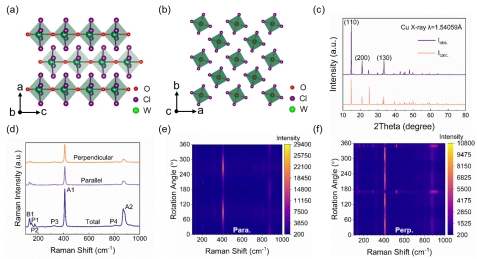
Figure 1. WOCl4 single-crystal structure and polarized Raman spectra.
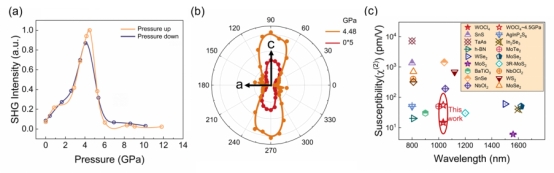
Figure 2. Pressure-dependent SHG enhancement effect and comparison of nonlinear susceptibility with representative materials.
In this study, researchers experimentally realized the growth and nonlinear optical characterization of one-dimensional vdWs ferroelectric WOCl4 single crystals for the first time, verifying the physical correlation of “pressure-induced local structural distortion → microscopic polarity enhancement → macroscopic nonlinear optical response” at the single-chain limit. This provides a new approach for precisely modulating the optical nonlinearity of low-dimensional materials through lattice strain engineering. This research is of great value for promoting the development of advanced optoelectronic equipment such as high-efficiency miniature frequency converters, ultrathin optical modulators, and highly sensitive pressure sensors.
The corresponding affiliations of this paper are the School of Materials Science and Engineering, Harbin Institute of Technology; the Frontier Institute of Science and Technology, Xi’an Jiaotong University; and the Zhangjiang Institute for Advanced Study, Shanghai Jiao Tong University. Ming-Ye Zhang, an undergraduate student in the School of Materials Science and Engineering, Harbin Institute of Technology, and Feng-Feng Ye, a doctoral student at Xi’an Jiaotong University, are the first authors. Professor Yang Li, Associate Researcher Zhen-Jie Guan, Associate Researcher Yu-Qiang Fang, and Professor Gao-Yang Gou are the corresponding authors. This work was supported by the National Natural Science Foundation of China, the State Key Laboratory of Electrical Insulation and Power Equipment, and other funding sources.
The paper link is as follows:
https://onlinelibrary.wiley.com/doi/10.1002/lpor.71869