

on WeChat to
follow us

Research
Follow

Address
92 Xidazhi Street, Nangang District, HarbinZipcode
150001Tel
0451-86413909,86402590 10
10 Recently, Professor Xiaoxiao Huang, from the team of Academician Yu Zhou at the School of Materials Science and Engineering and the State Key Laboratory of Advanced Welding and Joining, Harbin Institute of Technology, has achieved significant progress in the field of electromagnetic wave absorbing materials. The related review, entitled Advances in TMDs-Based Electromagnetic Wave Absorbers: From Structural Engineering to Multicomponent Synergy, has been published in Nano-Micro Letters, a leading journal in the fields of materials science and nanotechnology.
With the explosive growth of 5G/6G communication, military radar, and satellite technologies, electromagnetic pollution has emerged as a critical threat to both electronic device security and public health. Ideal electromagnetic wave absorbers are required to simultaneously satisfy the stringent demands of thin thickness, light weight, broad bandwidth, and strong absorption. However, conventional absorbers struggle to achieve a balance between impedance matching and high attenuation across wide frequency ranges. Transition metal dichalcogenides (TMDs), such as MoS2 and WS₂, have emerged as promising dielectric absorbers due to their unique two-dimensional layered structures, tunable electronic properties, and abundant intrinsic defects. Nevertheless, systematically exploiting these multidimensional tunable characteristics to design high-performance absorbers remains a core scientific challenge in the field.
To address this bottleneck, the research team systematically elucidated the design logic of TMDs-based absorbers and established two core strategic frameworks. The first involves multiscale structural engineering of pure-phase TMDs, spanning atomic-scale defect and doping regulation, nanoscale 1T/2H phase engineering, and micrometer-scale morphology manipulation including nanoflowers, hollow spheres, and three-dimensional aerogels, thereby achieving cross-scale synergistic optimization of electromagnetic parameters. The second focuses on multicomponent synergistic composites, constructing abundant heterointerfaces by integrating TMDs with carbon materials, MXene and other dielectric materials, as well as magnetic components, to achieve synergistic enhancement of conduction loss, interfacial polarization, and magnetic loss.
This review provides a systematic theoretical foundation and a clear research roadmap for the rational design of next-generation high-performance TMDs-based electromagnetic wave absorbers. It highlights that the value of TMDs lies not in the extremity of any single performance indicator, but in the unprecedented multidimensional tunability it offers for balancing impedance matching and attenuation capability. Furthermore, it identifies the key pathway for the field's transition from empirical trial-and-error to rational design, encompassing machine learning-assisted inverse design, scalable green manufacturing technologies, and multifunctional integration of microwave absorption with thermal management, mechanical load-bearing, and environmental tolerance.
The first author of this article is Yuefeng Yan, Associate Research Professor at the School of Materials Science and Engineering, Harbin Institute of Technology. The corresponding authors include Professor Xiaoxiao Huang from the State Key Laboratory of Advanced Welding and Joining,
This work was supported by National Natural Science Foundation of China (NSFC 525B2034, 52432002, and 52372041), and the Fundamental Research Funds for the Central Universities (Grant No. HIT.DZJJ.2025002)
Article link: https://doi.org/10.1007/s40820-026-02266-w
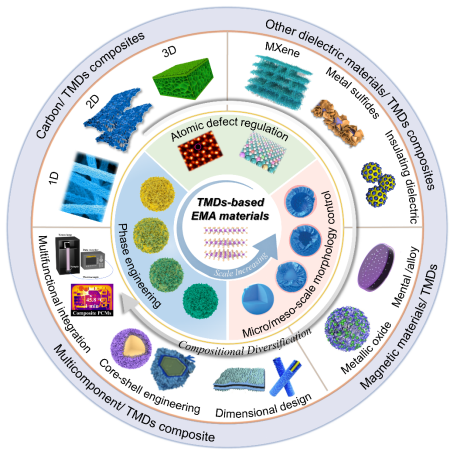
The multi-scale and multi-component design approach for TMDs-based electromagnetic wave absorption materials